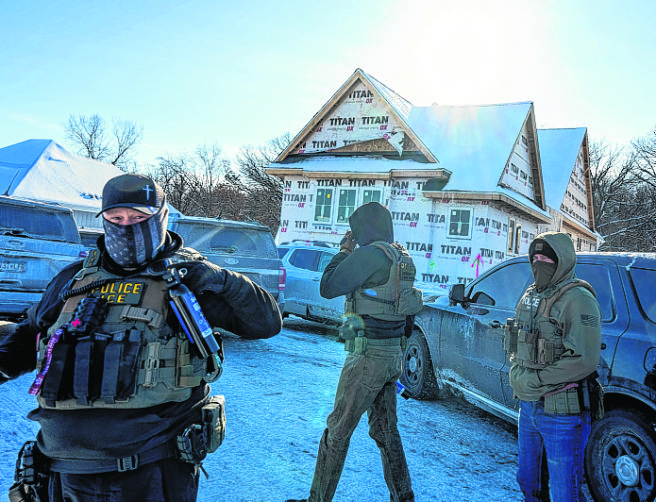


I work as a roofer in Minneapolis. Or rather, I used to work as a roofer. I have not for the past three months because of Operation Metro Surge and I am not sure when I will be able to safely return to work, as is the case with many other construction workers I know.
I am an immigrant and work for a contractor who is also an immigrant, and by the second week of December he decided to pause our projects indefinitely. The risk of being harassed and detained, regardless of immigration status, was too great.
The delays to projects have been far-reaching. In December, Minnesota led the nation in construction job losses, and pending home sales in the Minneapolis metro area dropped nearly 20% in January. This lines up with what I have witnessed in my own life: Virtually every construction worker I know has either greatly reduced their hours or completely stopped working because of the federal occupation.
In December, I also started hearing about horrible situations of workers being trapped on roofs in dangerous subzero temperatures by ICE agents who did not have proper warrants. In one such case in Chanhassen, one worker was eventually detained and the other ended up being taken to the hospital for cold exposure.
Hearing about how other roofers were being harassed, unlawfully detained and put in life-threatening situations also confirmed to me that I could not work safely during the occupation. Especially with my three teenagers at home, that was a risk I could not take. A few days later, my boss let us all know we would be indefinitely pausing our projects for safety reasons, so it was no longer a choice I could consider anyway.
Unfortunately, not being able to rely on a safe work environment is nothing new for construction workers in the Twin Cities. I have been involved in organizing for safer labor conditions for construction workers in the Twin Cities for several years, ever since I suffered my own case of sexual harassment and wage theft back in 2023. I know my case is far from unique.
According to a 2021 report from the Midwest Economic Policy Institute, 1 in every 4 construction workers in Minnesota experiences some form of wage theft. And according to a report from the Institute for Women’s Policy Research, more than 57% of female construction workers are either sometimes or frequently sexually harassed.
Now these issues like wage theft, assault and discrimination have been further aggravated by the harm and violence of Operation Metro Surge. The threat of ICE on worksites has created an environment of fear that has pushed workers further into the shadows. This harms all workers, regardless of immigration status.
Throughout the occupation I saw neighbors protect each other, churches and organizations raise money for rent, and workers and businesses join together to shut down for a day in protest of the lawless violence from ICE. But one voice that was notably absent in the construction industry was that of influential developers.
I want this to be clear: There are powerful actors who could have stood up for us construction workers during Operation Metro Surge but chose not to. Major developers such as United Properties and D.R. Horton, some of the largest developers in the Twin Cities metro area, could have called for an end to the occupation and could have banned ICE from their construction sites without a valid and signed judicial warrant. Their silence and inaction caused real harm to working families such as my own, and a crisis within the construction and housing industry at large.
Since January, workers and allies have sent nearly 20,000 letters to major developers in the Twin Cities asking them to take basic protective measures. Businesses put out bland statements calling for “de-escalation,” and wealthy business owners fawned over the resilience of Minneapolis residents. But they failed to publicly denounce ICE’s actions or take other public stances. Refusal to take basic action to protect workers has created a cascade of impacts that workers and the entire Minnesota housing industry will feel for months, if not years.
Even if ICE leaves, or returns back to normal levels of agents on the ground, many construction workers are still not safe at work if basic labor rights aren’t protected. Over the past nearly five years, workers have been inviting United Properties to join the Building Dignity and Respect (BDR) program to eliminate labor exploitation in the nonunion construction industry. This independent monitoring program would ensure that workers have a voice on their worksite, training on workplace safety and rights, and a mechanism to report labor violations or any other safety issue without fear of retaliation.
Workers have to feel safe returning to work in order for construction projects to resume and the industry to recover from this crisis. Developers must join the Building Dignity and Respect program to work directly with construction workers to ensure we not only recover from this crisis, but create a construction industry in Minnesota that centers workers’ safety, dignity and respect. Esmeralda Rosas is a roofer who is a member of Centro De Trabajadores Unidos En La Lucha (CTUL), a Minneapolis-based worker center.
This commentary was translated by Jac Kovarik, the communications coordinator for CTUL.