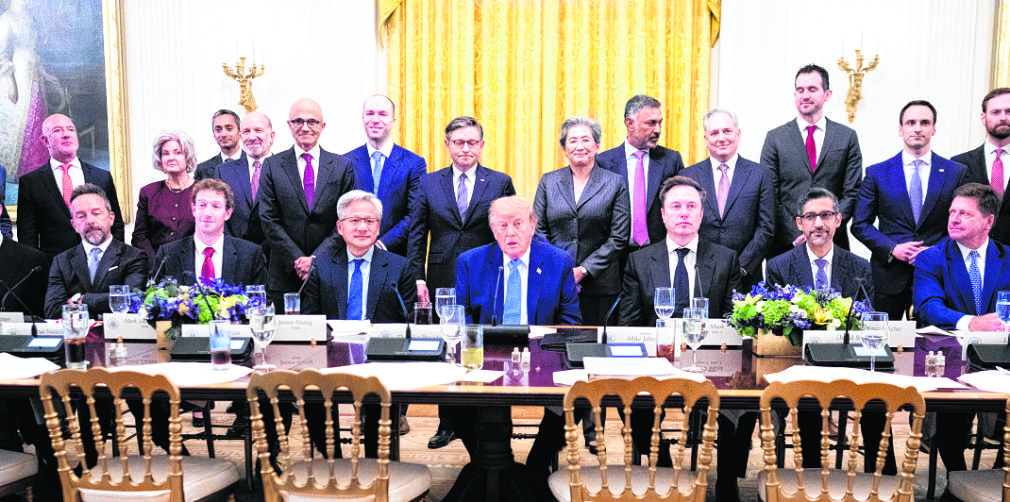


SAN FRANCISCO – In September, President Donald Trump hosted a White House luncheon to discuss artificial intelligence, flanked by some of the world’s wealthiest tech executives: Jensen Huang of Nvidia, Elon Musk of Tesla and SpaceX, Mark Zuckerberg of Meta and others. They had the president’s ear to pitch an AI future uninhibited by regulation or guardrails.
For two years, it had been that easy to get what they wanted. Tech billionaires and money to Trump’s favored causes, including the White House ballroom. The moguls posed for photos and lavished him with praise and gifts. Amazon heavily promoted a movie about Melania Trump.
Then on Tuesday, the American public delivered a rebuke of the tech industry’s agenda.
Overnight, the billionaires’ political alignment with the president may have become a liability.
Democrats, riding a wave of anti-tech sentiment, including distrust of tech leaders, opposition to data centers and fears of job loss fueled by AI, will soon control Congress and prominent state governments.
In victory speeches around the country, they made tech titans avatars of inequality and corruption that plagued the Republican Party in the election cycle.
That puts some tech executives in a trickier position. It may be harder for them to make progress on their goals of AI dominance. Many saw their net worths drop Thursday as investors sold out of AI and chip stocks, driving the tech-heavy Nasdaq down more than 5%.
And some may even find themselves under investigation.
“You guys aren’t the actual leaders of the Valley. You’re the mis-leaders of the Valley,” said Reid Hoffman, a founder of LinkedIn who is one of the country’s top Democratic donors and a leader of the tech industry’s progressive wing.
“It will no longer be that these MAGA voices in the Valley are in charge.”
Silicon Valley’s shift to the right began in 2024, when Musk and others went all-in on Trump, visiting Trump’s Mar-a- Lago estate in Florida and taking up powerful positions in his administration. New political groups supporting niche interests like cryptocurrency spent enormous sums to promote their agendas.
This time, the money was even bigger. Among the 20 biggest donors in the midterms were tech billionaires, including venture capitalists Marc Andreessen and Ben Horowitz.
An Andreessen-backed cryptocurrency group, Fairshake, spent tens of millions on a mission to defeat Sherrod Brown, the Democrat running for Senate in Ohio. Musk poured over $474 million into Republican super political action committees, including hundreds of millions to support Ken Paxton, the Texas Republican nominee for the Senate. And a Musk-endorsed billionaire ran for governor in Ohio.
All three efforts failed.
Musk’s results, said Rohan Patel, a former Tesla vice president reporting to Musk who now works in Democratic politics, are a “total repudiation of his ugly brand of politics.”
Neil Malhotra, a professor of political economy at Stanford University’s Graduate School of Business, said tech leaders had mostly been acting out of self-preservation.
“They understand when you have a president who is willing to use the state to intervene in the economy, it’s smart business practice to be on good terms with the administration,” he said.
Malhotra noted that most business leaders would rather that the government not move too far from the center in either direction. After the 2024 election, “Republicans overinterpreted their mandate,” he said.
Now tech leaders may find their business dealings under investigation. “They are going to need to plant new forests for all of the subpoenas we’ll be printing,” Sen. Edward Markey, D-Mass., posted on social media Tuesday.
The tech titans appeared triumphant in one race: A proposed billionaire tax in California is on the cusp of being defeated. Sergey Brin, a cofounder of Google, and other tech investors and founders poured about $330 million into efforts to vanquish the measure, which called for a one-time 5% tax. A companion measure that would effectively ban all future wealth taxes also appeared likely to pass.
Still, anti-billionaire and antitech sentiment was prominent in victory speeches around the country. Paxton’s opponent in Texas, James Talarico, whom Hoffman backed with nearly $17 million, compared his race to David vs. Goliath.
“We just sent a message to every billionaire megadonor, every trillionaire megadonor,” he said. He called out “the billionaires who own the social media algorithms, who own the cable news networks, who own the politicians.” This election was a referendum on their power, too, he said.
Roy Cooper, a Democrat who won a Senate seat in North Carolina, said in his victory speech Tuesday that “we told Washington loud and clear that North Carolinians will always matter more than the billionaires and the insiders.”
The left-wing victor in Michigan’s Senate race, Abdul El- Sayed, said he would be “taking on the corporations and the billionaires, special interests who’ve rigged the system against us for far too long.”
And Sen. Jon Ossoff, a Democrat who won re-election in Georgia, called out “the titans of Silicon Valley,” who “dig bunkers for themselves and warn that the artificial intelligence they’re creating risks human extinction.”
Late Tuesday, as the results of the election rolled in, the hosts of the tech podcast “All-In,” who are tech investors, expressed surprise and disappointment in a livestream at the possibility that Texas’ Republican governor, Greg Abbott, could lose his bid for a fourth term.
The tech industry had assumed that after Abbott won, he would lift a moratorium on data centers in Texas and that construction would begin again, the “All-In” hosts said.
Pro-business Texas is the second-largest state for data center projects, representing roughly 30% of the planned capacity for 2028, according to SemiAnalysis, a research group.
Gina Hinojosa, the Democrat who beat Abbott, has said she would keep the moratorium going until the state could pass legislation around data centers, delaying projects from coming online for many months.
Chamath Palihapitiya, an “All-In” host, connected the slowdown or halt of data center projects to the performance of AI-related stocks and, ultimately, the fate of the U.S. economy.
He warned of a recession, noting that losing the computing power of new data centers was the “single most effective way to tank the market.”
Musk, who donated $5 million to Abbott’s campaign, posted on social media after the results, “Data centers in space looking pretty appealing right now.”