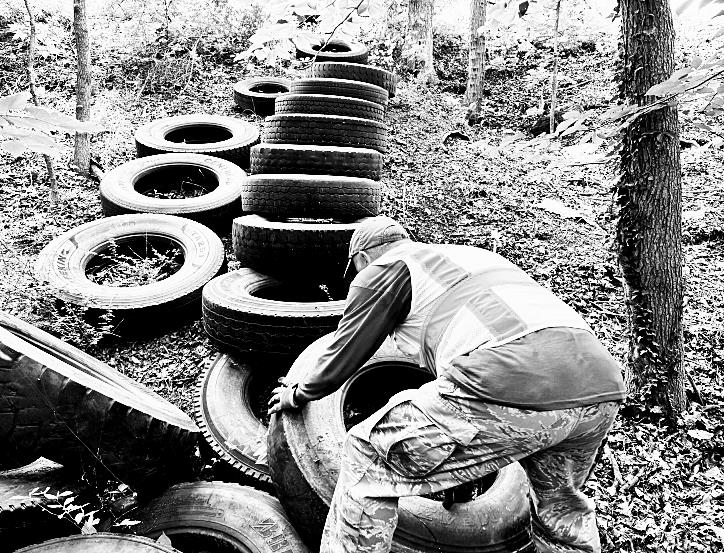


Soaked in dark, stagnant water and sweat, Jon Merryman stood at the bottom of a Maryland ravine choked with poison ivy, trash and his arch nemesis: illegally discarded tires.
A swarm of mosquitoes buzzed around his head, but just like the occasional rat, snake or hornet’s nest he’s uncovered over the years, he seemed unfazed by the bloodsuckers.
Only tires truly grate his soul.
“For some reason, they tick me off more than anything,” he said, wiping his brow and standing near Greenbelt Park in Prince George’s County. “I definitely hate tires.”
Merryman, 62, squatted down low and took a firm, twohanded grip beneath a massive tractor-trailer tire. With a grunt, he deadlifted the heavy rubber and flipped it up the slope. He did this over and over, tire by tire, for days until he’d built an impressive staircase about 50 feet up to the guardrail along the shoulder of busy Kenilworth Avenue. Up and down the roadway, piles of trash and tires he wrestled up from the depths sat, waiting for highway cleanup crews to haul them away.
Merryman usually contacts the crews ahead of time to let them know he’s cleaning up, and he said he’s never had a problem.
Some people pay money to do this at a gym, but not at the swamps, ditches, dead ends and other illegal dumps where you’ll find Merryman on any given day, in various corners of the country. The average automobile tire can weigh up to 25 pounds, and truck tires can range anywhere from 35 to 100 pounds or more. He drinks a lot of water to combat leg cramps.
On a recent afternoon, the Baltimore County resident was not far from home, but he’d also recently visited Philadelphia to help hundreds of others clean up a mountain of tires dumped by a creek there. He always wears gloves, a fluorescent vest for visibility and insect repellent.
So far this year, Merryman has also wrangled tires in South Carolina and Florida and attended something called a “tire party” in Atlanta. He has a goal of cleaning up trash in every county in America — there’s more than 3,000 of them — often with his trusty orange bucket, trash tongs and his mascot, Sharkey D’Shark.
The plastic, Great White shark was trash of course, but Merryman said it was “too cool” to actually throw away, so he uses it in his social media posts about garbage pickups.
Merryman said he will be in Alaska around Labor Day for vacation, but he’s carved out some time to pick up trash in new counties there, too.
“I used to call him ‘tire man,’ but I also call him the ‘trashiest man in the whole Patapsco Valley,’ ” said Betsy McMillion, the former environmental education programs director with the Patapsco Heritage Greenway , Earlier this month, Merryman took a non-tire-related vacation to South Korea with his wife, Kirsten, and once he got to Jeju Island, he couldn’t help himself.
“There’s a lot of trash there,” he said. “I was picking up trash all over the place.”
This is what retirement looks like for Merryman. Fellow tire haters say the world should feel blessed that the former Lockheed Martin software designer didn’t just take up golf or birding.
He is one man against seemingly insurmountable odds, they said, and yet he soldiers on.
“He’s proof one man can make a heck of a difference,” said Scott Zillmer, a map editor for National Geographic who has accompanied Merryman on dozens of cleanups.
When asked how many tires he thinks he has hauled away by himself, Merryman s aid he averages about 900 to 1,000 tires a year, though he’s on track to beat that average this year. “Probably over 15,000 total, and that’s a conservative estimate,” he said.
M erryman rejects fingerpointing, arguing that littering is a collective problem requiring collective responsibility.
His optimism rests on the simple math of removal: Every bag collected means less pollution.