

A Duluth psychotherapy provider allegedly submitted more than 27,000 false claims to the state, billing Medicaid for more than $2.2 million in services he did not provide, according to the Minnesota Attorney General’s Office.
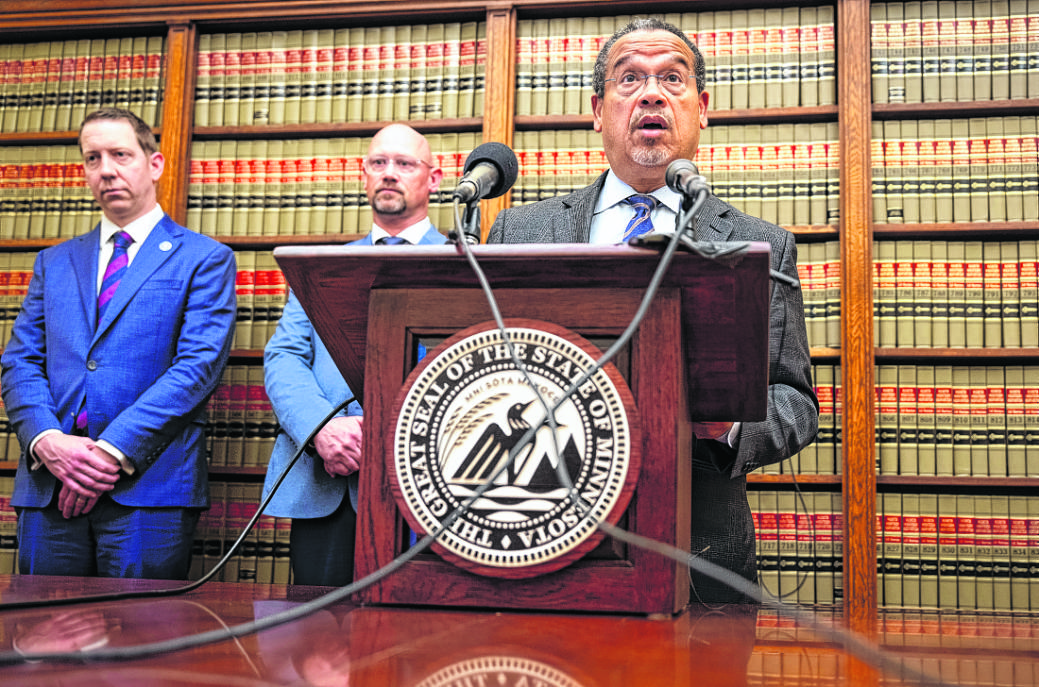
The provider was one of nine people charged in connection to various Medicaid fraud cases, Attorney General Keith Ellison announced Tuesday.
The providers allegedly stole a combined $3 million through different Medicaid programs.
Others were charged with fraudulently billing for personal care assistance and home- and community-based services. One person was also charged with financially exploiting a vulnerable adult.
“I am angry about people who steal from these public programs, and we’re here to protect the public dollar,” Ellison said during a news conference Tuesday. “It’s just not tolerable that low-income folks who need health care for home care or personal services would have those services stolen from them.”
The Medicaid fraud cases are the latest for a state that has struggled to prevent bad actors from exploiting its social service programs. Fraud in those programs is a top political issue this election season, including in Ellison’s bid for a third term, and has been Gov. Tim Walz’s primary focus during his final year in office. It has also prompted the Trump administration to withhold Medicaid funds to the state.
This week Peter Jason Meilahn, 50, of Duluth was charged with 13 felony counts tied to the alleged psychotherapy scam.
Meilahn, a licensed professional clinical counselor, was an independent practitioner at Franklin Family Services and submitted claims for reimbursement for psychotherapy services he reportedly provided in office,at recipients’ homes and via telehealth. He also had his own practice called Individual Services.
Fraud investigators with the Attorney General’s Offi ce found 27,430 instances where he submitted claims for services that were not provided. Supposed recipients of those services said they never had a session with Meilahn, or had a couple sessions but no follow-ups.
Investigators talked to 19 people who said they were not aware he had submitted Medicaid reimbursement claims for services he supposedly provided to them or their children between 2020 and 2025.
There were 468 days over six years in which Meilahn claimed to provide more than 24 hours of service on a given day, fraud investigators found.
The Minnesota Department of Human Services said in a statement that it withheld payments to Individual Services and Meilahn in August 2024 and terminated his Medicaid enrollment this January. Officials noted DHS has added measures in recent years to prevent and detect fraud earlier and build evidence to charge people who exploit programs.
“Assembling strong cases against perpetrators of fraud takes time, intelligence, resources and close collaboration among many government agencies,” DHS Inspector General James Clark said in a statement. “When the department found credible evidence of fraud involving businesses at the center of today’s charges, we shut off the money and terminated the providers.”
Another case the attorney general highlighted Tuesday focused on a personal care assistance agency called Always on Time Health Services, which allegedly stole more than $675,000 from the state’s Medicaid program.
Awo Mohamed of Roseville and three co-conspirators were charged with felony theft offenses for billing for services that weren’t rendered or were not eligible for reimbursement. The Attorney General’s Offi ce said it worked with other state and federal agencies on those cases.
Fraud investigators starting looking into Mohamed after finding ties between Always on Time and other companies under investigation.
DHS officials said the agency withheld payments to Mohamed and Always on Time in September 2023 and terminated their Medicaid enrollment the following September. The agency also terminated another of Mohamed’s companies, AK Care Center, at that time. That company was enrolled to provide services under the state’s Housing Stabilization Services program, which was shuttered last year over concerns of widespread fraud.
Ellison’s office noted their Medicaid Fraud Control Unit has secured 358 Medicaid fraud convictions since 2019. This year state lawmakers devoted money to bolster staff in the unit, gave the office additional legal tools and raised penalties for some convictions.
The unit has 220 open cases and many additional referrals they are preliminarily investigating, said Nicholas Wanka, the unit’s director.
“We’ve got more resources and more people power than ever,” Ellison said. “We’re not going to sit around and let people steal from these programs.”
Ellison said while there’s hope the court system will be able to recover some of the lost funds, often the courts are not able to collect stolen dollars. jessie.vanberkel@startribune.com