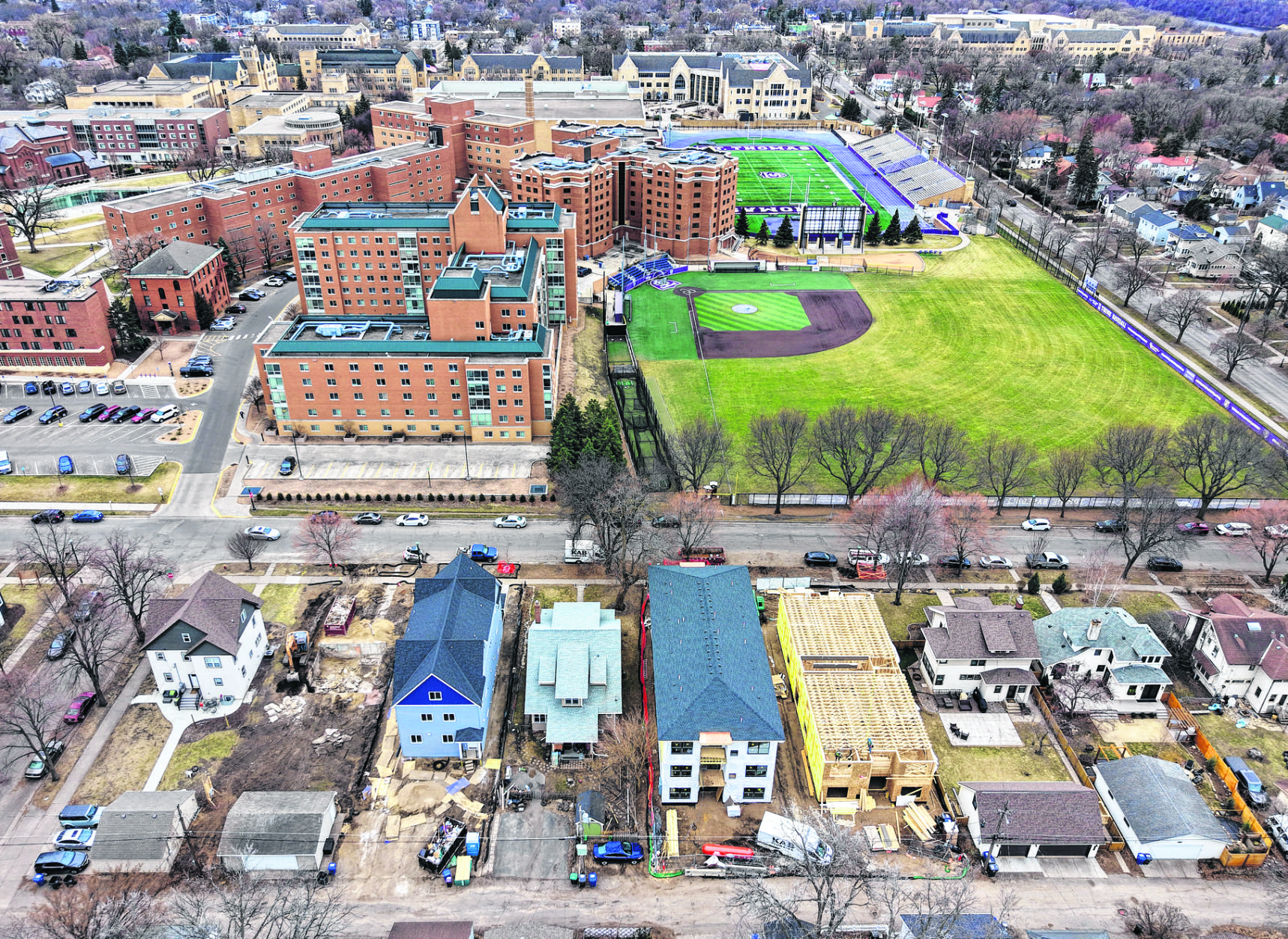
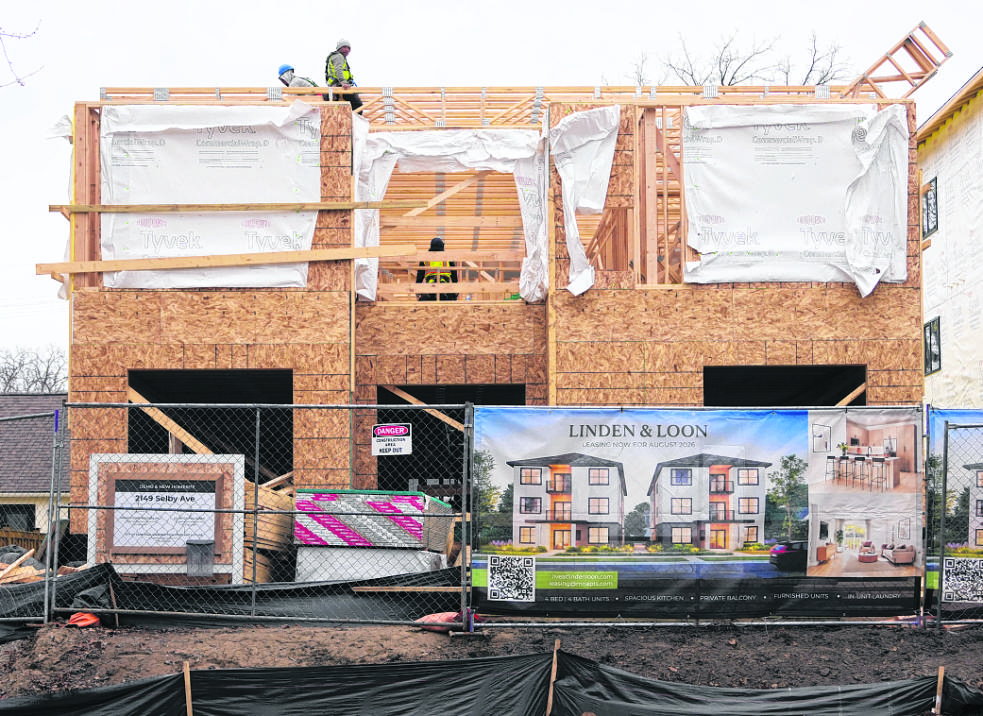
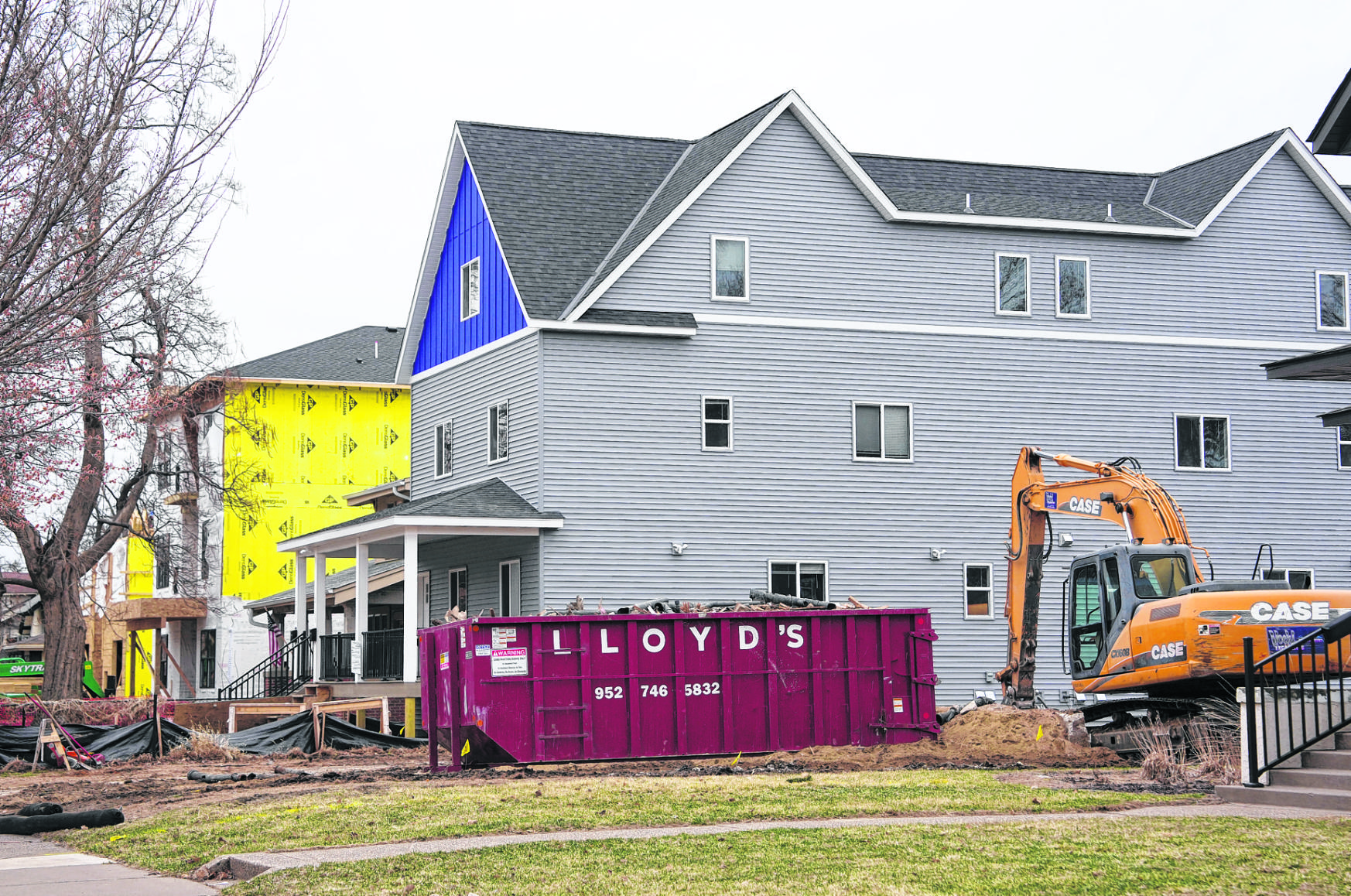


Jesse Korinek lives sandwiched among four construction sites, as two apartment buildings rise on each side of his house on St. Paul’s Selby Avenue.
Four of the 12 houses on his block have been torn down since last fall, making way for new development catering to college students at nearby University of St.
Thomas. Dozens of others have been torn down on surrounding blocks.
“I can’t sugarcoat it, it’s a living nightmare,” Korinek said, noting the construction noise and the loss of sunlight in his backyard.
He and many of his neighbors worry about the speed and intensity of the change, with big duplexes and apartment buildings sprouting where single-family houses once stood — something made possible by a city zoning change in 2023. And while many of them enjoy living near the college, they’ve grown increasingly uncomfortable with St. Thomas’ expanded footprint and big ambitions as a Division I school.
The fast redevelopment, which has seen some of the well-to-do area’s smaller houses torn down, has upset the balance of the neighborhood.
“Every time we walk around the block, there’s a house missing,” said Sherri Bergene, one of the remaining homeowners on her block of Selby Avenue just north of campus.
The energy of the college is part of why Bergene moved to Union Park a decade ago.
“You develop a relationship with the students, there’s a mutual respect,” Bergene said.
She likes the rotating cast of football players who live next door in a rental house. She also likes being able to watch Tommies baseball games from her roof.
Korinek often got to know the students who had rented the now-demolished house next door, usually groups of three or four every year. But he wonders if he can have the same kind of neighborly relationship with the 24 students who will occupy the new apartment building.
More density, mostly here
The city’s 2023 zoning overhaul allows bigger apartment buildings in most neighborhoods.
The changes were meant to spur apartment construction, with the idea that more apartments would bring down rents citywide.
So far, the Macalester Groveland and Union Park neighborhoods — especially the blocks around the University of St.
Thomas — have seen more of that new density than other areas. A group of neighbors tracking development have counted 30 single-family houses demolished since 2022, all within a half-mile of the St.Thomas campus.
“One of the most frustrating parts has been the disconnect between what neighbors thought would be happening when the zoning changed, and what’s happening,” said Tim Flanigan, another Selby Avenue resident.
The blocks north of St.Thomas have plenty of centuryold duplexes, fourplexes and smaller apartment buildings, and residents don’t mind the idea of more of that.
Korinek had even hoped to eventually build an apartment himself over his garage for one of his children.
What is irksome, Bergene said, is the size of new duplexes and fourplexes, towering a full story above the neighboring houses, with most clad in vinyl siding.
Flanigan noted the cost too: most listings he has seen are around $6,000 per month for half of a duplex, well out of reach for most families, he said.
Many apartments are rented out by the room for somewhere around $1,000, he said, with listings that make clear they are for students, not families.
St. Thomas started requiring first- and second-year students to live on campus in 2021, said Jerome Benner, the university’s director of neighborhood and community relations.
Benner said about half of the university’s 6,000 undergraduate students live on campus.
And more students want to live in the dorms, he said: about 500 upperclassmen were turned away for on-campus housing this year.
Over the next decade, the university is hoping to build new dorms to accommodate about 500 students on property the university owns on Summit and Grand avenues, though the plan is controversial with neighbors.
“We’re trying to listen to neighbors and hear their concerns,”Benner said.
The area around St. Thomas is also governed by a “student overlay housing district,” a special zoning designation that was meant to prevent a Dinkytownesque concentration of college students in the neighborhood by prohibiting student rentals next door to each other.
Several of the new buildings are far closer together, however, because the overlay district only applied to single-family houses and duplexes; triplexes and larger apartments can cluster.
“There’s been a lot of frustration with the way the development has been poorly managed by the city,” Flanigan said.
Permit questions, frustration with the city
The development has been moving so fast that some houses have been torn down before demolition permits are finalized.
“There’s a lot of disconnect between what developers should be doing and what’s happening on the ground,” Flanigan said.
Angie Wiese, the Department of Safety and Inspections director, said because the demolition of a house can be so quick, the city does not always hear about these teardowns before they’re done.
“We actually don’t have tools to penalize other than a stop work order,” Wiese said. (The city is still working to set up the administrative citations system approved by voters in 2025, which will let the city issue punitive fines.) Wiese said the city largely relies on neighbors to call when they see problems at a building site, but the Selby Avenue neighbors said they have little faith in the city to make sure everything is done by the book.
“More housing units do get built in the city,” Flanigan said, but he worries that his neighborhood will shut out families if all the new construction is student-focused.
Neighbors are trying to get more organized and look at ideas beyond a building moratorium they proposed last year, he said: “We’re trying to work on solutions.”
josie.grove@startribune.com
“One of the most frustrating parts has been the disconnect between what neighbors thought would be happening when the zoning changed, and what’s happening,”
Tim Flanigan, Selby Avenue resident