

As China’s government pushes its citizens to embrace artificial intelligence, it is confronting a problem partly of its own making: overreliance on the technology.
State media reports have featured stories that serve as cautionary tales: a farmer who lost 25 acres of seedlings after asking AI for advice, children who have become so attached to chatbots that they want their parents to speak like them and AI-generated micro dramas with characters that look like carbon copies of one another.
These cases and others have raised concerns in China that as it rushes to catch up with the United States in AI, it is running into adverse side effects created by the new technology, which is accused of undermining human relationships and depriving people of their better judgment.
The government, seeking to direct how people use the technology, has responded by imposing new regulations and judicial guidelines on its use — and misuse.
The response reflects how the ruling Communist Party is trying to balance its ambitions to promote the widespread use of AI with a desire to avoid anything that might undermine social order, say analysts.
The party is “recognizing that the more they develop the technology, the more there’s going to be social challenges that they have to deal with,” said Scott Singer, a fellow and co-director of the China AI Initiative at the Carnegie Endowment for International Peace.
“Where the party is sensitive is any area where they feel like the technology is getting better in a way that fundamentally could disrupt social stability.”
Singer said the party is particularly sensitive to disruptions caused not only to human relationships but also the job market as AI threatens to replace workers.
Concerns about overuse are shared among China’s citizens, who say they see the spread of the technology as inevitable even as they question its benefits and tire of its ubiquity.
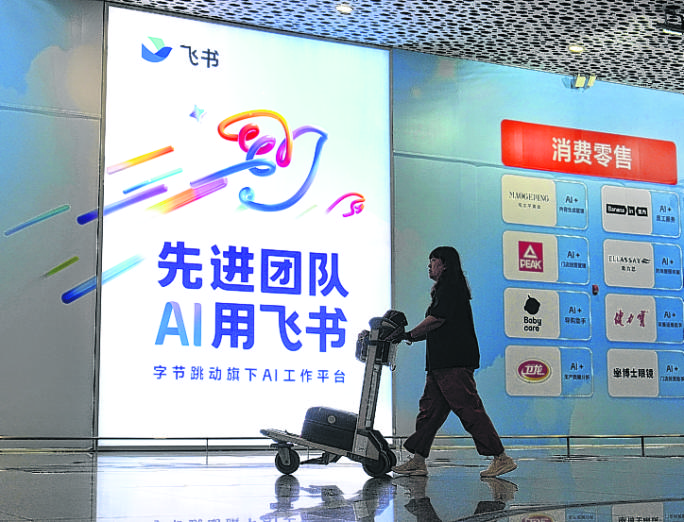
Xie Tong, a graphic designer in Beijing, uses AI in her own work at a consulting agency and can no longer imagine her life without it. But she despairs at encountering AI all around her — in the subway ads that she sees on her commute and in the work of contractors at her job who obviously relied on AI.
“It’s like a marriage where you curse your partner but you can’t leave them,” she said.
For a time, China’s AI push created a boom in virtual companion apps, including ones offering romantic partners, personal tutors and AI avatars of family members.
In a country already struggling with a shrinking population and a historically low birthrate, the proliferation has led to concerns from Beijing about AI replacing human relationships.
State media quoted experts saying people could soon find it hard to navigate real interactions.
Reports cited a 2025 survey by the China Youth and Children Research Center of more than 8,500 minors that showed more than 20% “only wanted to chat with AI and did not want to talk with real people.”
That mirrored the concerns of some parents such as Vivian Lyu, a stay-at-home mother in Hangzhou who two years ago introduced her 5-year-old daughter, Polly, to Doubao, an AI assistant created by Byte- Dance, the parent company of TikTok.
Soon, the child was chatting with the AI and a personalized companion on the app nearly every day. At first, Lyu thought the AI was good at keeping Polly entertained when the mother had to take care of household tasks. “When you feel like you don’t have a choice, you use Doubao,” she said.
Over time, though, Polly started asking for Doubao instead of seeking out activities that used to interest her, like playing with other children or drawing pictures. Lyu said she worried that the chatbot was warping her daughter’s understanding of how relationships worked, saying that Polly sometimes talked to Doubao in a “very self-centered, doingwhatever-she-wants kind of way.”