

The 2019-20 season for St. Thomas was going well, but athletic director Phil Esten had one complaint.
“We had one dunk the whole season,” men’s basketball coach John Tauer recalled. “[Esten’s] like, ‘When are we going to start dunking?’ ”
That was then. This is now.
After a summer practice, Tauer yelled across the court to Isaiah Johnson-Arigu: “Isaiah, do something.”
On cue, the Maple Grove native threw the ball off the backboard and flushed it for a two-handed slam.
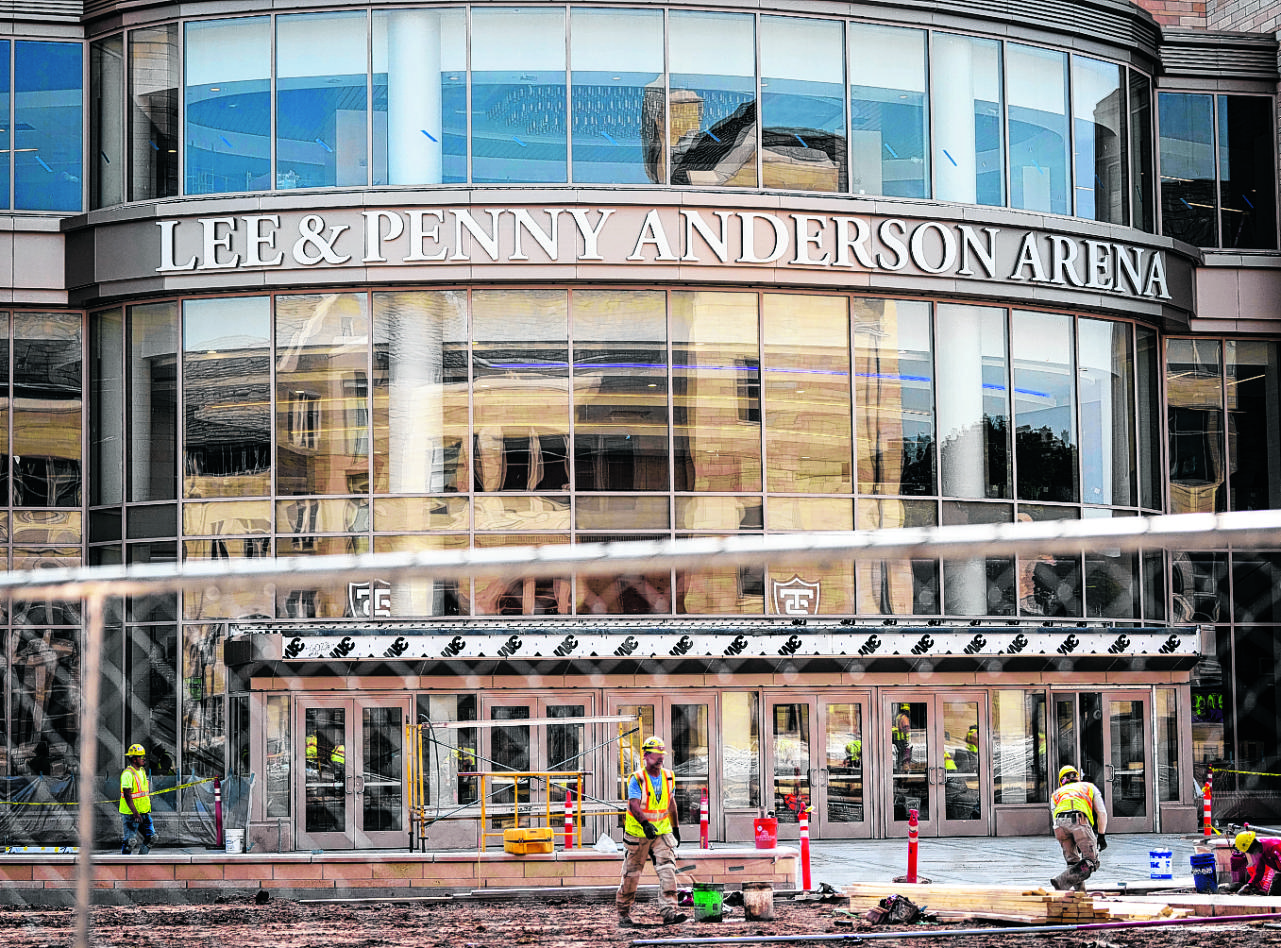
Esten stood nearby in a hard hat and neon vest in the thenunder construction $175 million Lee & Penny Anderson Arena, which opened Friday, chatting with a prospective recruit.
“Thank you,” Tauer shouted, before returning to his point: Johnson-Arigu, who has played at Miami (Fla.) and Iowa, is the kind of player St. Thomas couldn’t have landed just a few years ago.
But the Tommies aren’t the same program.
Once a Division III powerhouse pushed out of its longtime home, the Minnesota Intercollegiate Athletic Conference (MIAC), for being too dominant, St. Thomas is entering its first year as a fully instated Division I member.
The Tommies are the first college in the nation to jump directly from Division III to Division I. Their transition, initially planned for five years, was shortened to four in an NCAA Division I Board of Directors vote in January. Now, with upgraded facilities, deeper recruiting reach and a broader national profile, St. Thomas is beginning to land athletes who once seemed out of reach.
The average annual athletics budget for colleges in the MIAC in St. Thomas’ final season was less than $4 million. In its new league, the Summit League, the average is more than $29 million.
The Tommies have received tremendous support from their alumni and broader community.
They’ve received nearly $150 million in donations since the beginning of the reclassification process.
“The journey we’re on,” Tauer said, “there’s some days I pinch myself to say, look at all the things that have happened.”
‘The coolest story’
Nolan Minessale watched the NCAA tournament last year from home.
“It didn’t sit well,” the Tommies sophomore guard said.
“If you play in college, it’s your dream.”
But that dream was off limits.
Because St. Thomas was in its final year of transition from D-III to D-I, last season’s 24-10 team entered its conference championship game knowing it was the end of the road.
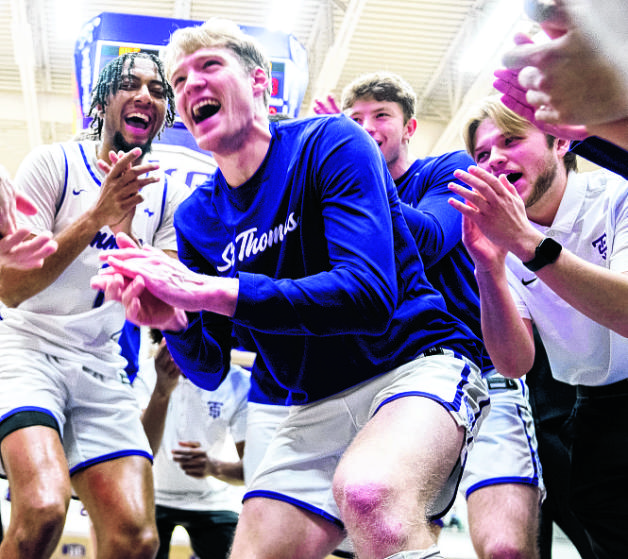
For players like Minessale and junior Carter Bjerke, it stung. But that was part of their recruiting pitch: being pioneers of the school’s new era.
“Being the first ones to ever do it,” Bjerke said, “we’re in the history books forever.”
Or, as Tauer put it: “They’re part of the coolest story in college basketball.”
When the Tommies tipped off their first Division I game in November 2021, the starting lineup was identical to its Division III lineup just six months earlier.
None of those players was recruited as a scholarship athlete.
The growing pains were clear. Facing full-fledged D-I rosters, the Tommies finished the 2021-22 season with 10 wins.
“We also lost 12 straight games and never, not once, was I worried about our culture fracturing,” Tauer said.
It wasn’t until last season that the program reached the full 13-scholarship limit after a year-by-year increase. With that came the athleticism and depth to contend in the Summit League, opening the door for recruiting classes like this year’s: three Power Four transfers and two ESPN four-star recruits. All five players are from the Twin Cities or Wisconsin.
“The ability to have St. Thomas as a Division I school now,” said Bjerke, a Plymouth native, “if I were a kid now coming out of high school in the state and a good recruit, I would absolutely be focusing my attention on St. Thomas.”
Now that all Tommies teams are eligible for NCAA tournaments, it’s a relief for returning players and a lure for transfers.
The men’s basketball team begins its season Nov. 3 at St. Mary’s (Calif.), a perennial NCAA tournament team.
“I was only going to go to a place that can make the tournament,” transfer Nick Janowski said. “Knowing that [St. Thomas] could make it, I knew pretty early that I was coming.”
‘Ready to take that jump’
Jada Hood, for many reasons, is excited about Anderson Arena.
“I hear we’re gonna get our fingerprints [scanned] to open the door … it makes me feel like I’m a secret agent,” said the women’s basketball guard, a graduate student.
Hood wants to be an FBI criminal profiler one day. Her teammate Savannah McGowan hopes to work in pediatrics. The two transfers are giddy about being Tommies.
When coach Ruth Sinn recruited the Twin Cities natives out of high school, she couldn’t offer them scholarships, so the two pursued opportunities in other states.
The transition to D-I made it possible for them to come home.
“Those scholarships being available, that was a huge thing for me,” Hood said.
St. Thomas was “always very, very competitive,” she added.
“So I think the jump was really just upgrading facilities, having more resources, adding more ingredients for the program to become successful.”
While the Tommies women’s basketball team is now eligible for the postseason, it faces another hurdle: South Dakota State has emerged as a midmajor powerhouse and the team to beat in the Summit League.
Sinn, whose team opens at nationally ranked Iowa State on Nov. 3, knows closing that gap will take time and credits her outgoing seniors for pushing her program in the right direction.
“They knew there wouldn’t be any postseason play,” Sinn said, “but they were about building the foundation for us to be able to really grow. … I think they’re ready to take that jump.
We’d like to be at the top of the conference, just where the men [are], vying for that spot.”
‘People are confused by this story’
When Tauer talks to his players after practice, it feels like a lecture. He paces, motions with his arms, asks questions and lofts statements into the air — waiting for players to fill in the blank.
Tauer doesn’t coach. He teaches.
When the St. Thomas alum returned to his alma mater as a psychology professor in 2000, he ran the Tommies offense as more of a side hustle.
Coaching is his full-time job now, and Tauer is still happy to hold forth about his Tommies.
“I think locally, especially, and nationally, people are confused by this story,” Tauer said before rattling off roughly 60 years of history in 60 seconds.
His dad graduated from the College of St. Thomas in 1963. In 1977, the school went co-ed. In 1990, it officially became a university. A law school came in 2001.
Then comes Tauer’s thesis: Moving to D-I isn’t some outof-character leap. Many urban Catholic schools — Marquette, Villanova, Gonzaga — have followed a similar blueprint.
“From President [Robert] Vischer to Dr. Esten, I think they have shepherded us through this transition incredibly well, being adamant that we’re not going to compromise our values, our academic integrity, or anything,” Tauer said.
Well, at least one thing has changed.
“Now we have players who dunk the ball more.”
shelby.swanson@startribune.com