

DULUTH
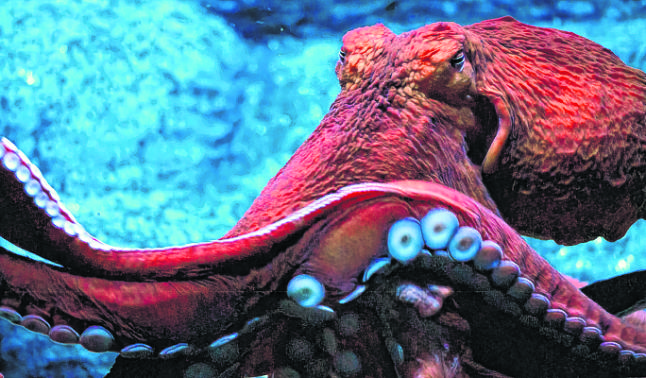
Fitzgerald, Great Lakes Aquarium photo the Giant Pacific octopus at the Great Lakes Aquarium, has tucked herself into a cave in her saltwater tank, a single reddish arm covered in suckers barely visible from the dark corner.
She is protecting the thousands upon thousands of eggs she has begun laying, small white dots that line the floor and walls of her nest. It’s a futile cause. The eggs aren’t fertilized. But nature insists she hunker down and protect them, regardless, occasionally snatching a rock or plant from the enclosure and pulling it closer to her cave for protection from predators that don’t exist here.
This period is called senescence — and it means the end of her life is near. “Now that she’s in her egg-laying stage, she’s been mostly just in her den,” said Adam Lein, the main aquarist who works with Fitzgerald.
Whether in an aquarium or the wild, the Giant Pacific octopus is a solitary creature with a short life span of three to five years. It lives until it lays eggs, fertilized or not, then settles quietly into its final months.
The Great Lakes Aquarium staff posted an update about Fitzgerald recently on social media, a post that drew thousands of responses, shares and comments from people interested in the creature’s life and end of life. Extra visitors have come to the exhibit, too.
For Lein, it was a relief to know that the octopus’ recent slowed interactions with keepers were a natural part of her life cycle and didn’t have a mysterious cause.
He called it bittersweet when they found the eggs. It was a surprise. Fitzgerald is just 2.
“Now she’s going to start her decline, unfortunately,” he said. “But that’s what they do.
They live until they’re reproductively mature, and then they lay their eggs, and then they pass away.”
Great Lakes Aquarium staff estimated Fitzgerald, named for the SS Edmund Fitzgerald, was about 9 months old when she became part of the Oceans Alive exhibit. She is 8 feet long from tip to tip and Lein estimates she is about 40 pounds.
She is most often a reddish hue, but can shift to match the neutral-toned rocks in her enclosure or turn whitish. She can open a peanut butter jar and fold around a Mr. Potato Head toy and remove its facial features.
“She’s curious, exploratory,” said Lein. “I would say she’s, most of the time, gentle.”
Sometimes, he added, Fitzgerald can get a little “tuggy” toward the few people she has gotten to know.
Fitzgerald lives in a tank that is about 12 feet long and 4 feet deep. It’s filled with plant-life she has been known to deconstruct, more than 20 starfish she sometimes steals food from and the rocks she pulls toward her nest.
While most octopuses have eight arms, Fitzgerald has eight and a half. One of the arms on the right side of her body is split, or bifurcated. It’s unclear whether she was born this way or if it was from an injury, Lein said.
Jean Brandt, a former school psychologist from Duluth, has been studying octopuses since reading Sy Montgomery’s book “The Soul of an Octopus” in about 2017. She used to call the aquarium and ask them to get an octopus. When they obtained Fitzgerald, Brandt began volunteering.
The two have developed a friendship.
Brandt has stood at the top of her enclosure and remembers the first time Fitzgerald popped out of the water and she connected with the octopus’ black, marble eyes. The octopus has wrapped her tangle of arms around Brandt’s arm. Octopuses learn from tasting and smelling, Brandt said.
When Brandt visits her, which she does about four times a week, the octopus seems to recognize her. She will come up to the glass, where Brandt places her hand, and twirl an arm.
“They’re just so intelligent,” Brandt said. “I feel like there’s something they have, a connection, a sixth sense or telepathy.
I feel like when I make eye contact with her, she really knows you care about her.”
Lein sometimes scuba-dives in Fitzgerald’s tank to clean it.
He vividly recalls coming faceto-face with the octopus in the water. Then she wrapped herself around his leg.
Brandt said that since the announcement about Fitzgerald’s waning life, she has seen visitors travel from Minneapolis and beyond to see her.
Fitzgerald will soon stop eating, unwilling to leave the nest to get food. Her color will fade and she will move even less.
Brandt has been preparing for this ever since she first saw the eggs Fitzgerald had laid — a visual that sent her scrambling to connect with Lein and made her heart beat faster.
“I have to face that,” she said. “It’s inevitable.”
christa.lawler@startribune.com